https://github.com/ultragrav/KAsyncWorld
Purpose
The purpose of this project is to provide a representation of a minecraft world that can be modified and processed asynchronously and off of the main server thread. Furthermore it is intended to provide a way to edit large parts of the world blazingly fast, and without causing lag. I also needed this project to provide an API for creating in-memory worlds, which are worlds in the game that are not backed by any files or folders on the host machine, but are stored completely in-memory and are volatile, leaving no trace behind after unloading. This project provides such an API and also provides a custom codec and format to serialize and deserialize these in-memory worlds in milliseconds, ensuring quick saving and loading functionality.
Problem
The Minecraft Server application is only single-threaded and cannot make use of multi-core systems. An annoying result of this is that none of Minecraft's internal world structures are thread-safe and there are many side effects of doing block processing.
Solution
This project provides an external api that is per-chunk thread-safe and can be handled entirely outside the main server thread. When changes are finished, a number of optimizations allow for the changes to be pushed to the real world extremely quickly and with only a single function call. Chunks must be written back to the real world on the main thread, but write-back is so optimized that speeds may reach up to a billion blocks per second in some cases. This is a tremendous improvement over standard Spigot APIs which grant the user speeds of less than a million blocks per second.
Features
- Asynchronous manipulation of worlds
- Fast write-back to real world (~500 million blocks/sec on MidnightSky servers)
- In-memory world creation and handling
- Blazingly fast custom world codec for in-memory worlds
- Sub-second load time for 16,000 chunk in-memory world
Timings
Here are some in-game tests done to measure the speed of saving/replacing/restoring a region of ~8 million blocks.

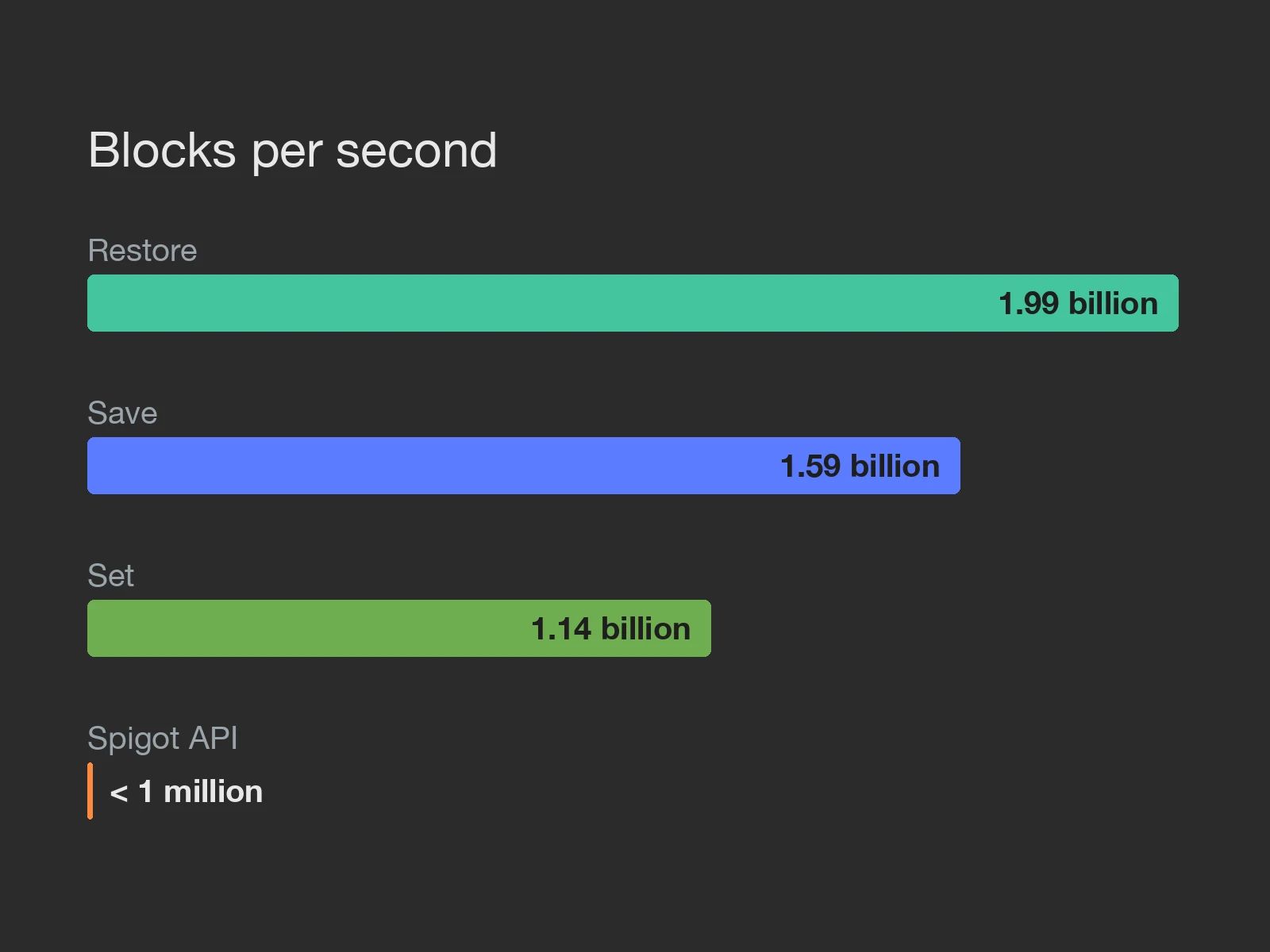
As you can see, both read and write speeds may exceed 1 billion blocks / second, which is over 1000x faster than through the Spigot API and even exceeds the speeds of the FastAsyncWorldEdit plugin.
Here's a simulation of what that looks like at a bigger scale, placing a 23x23 chunk area of terrain (~19.7 million blocks), slowed down 1000x. KAsyncWorld writes the chunks back in the order they were edited, in parallel batches, and finishes in about 17ms. At less than a million blocks / second, the Spigot API would need roughly 20 seconds for the same area.
Usage
Let's start with some examples first. This is a snippet from the source code of MidnightSky (some parts omitted for brevity)
val world = adv.map.world
val aw = AW.createAsyncWorld(world, AsyncWorld.EditType.SPARSE)

val sc = ..
val pasteAt = ..
Schematics.paste(sc, aw, pasteAt.x, pasteAt.y, pasteAt.z)

box = ..

// Kick out the people inside
..

aw.syncFlush()
This is another snippet from MidnightSky
fun destroyPrepStation() {
    val poi = map.data.poiList.first { it.type == WarMapPoiType.PREP_STATION }

    val dims = ..
    val x = poi.x.toInt() - dims.x / 2
    val y = poi.y.toInt() - 1
    val z = poi.z.toInt() - dims.z / 2

    val aw = AW.createAsyncWorld(world.bukkitWorld, AsyncWorld.EditType.SPARSE)
    val corner1 = Vec3i(x, y, z)
    val corner2 = corner1 + dims
    val box = corner1 box corner2

    aw.setBox(box, Material.AIR.createBlockData())
    aw.flush()
}
As you can see it is extremely simple to use. You might notice that aw.syncFlush() is used in the first snippet yet aw.flush() in the following one. The difference is that aw.flush() adds the changes to a queue that will ~eventually write the changes back to the real world (usually quite fast), and returns immediately. The queue will possibly spread the write-back over multiple game ticks so as to avoid lagging the server thread. syncFlush() also adds the edits to the queue, however it guarantees that the edits are written back completely before it returns, and if it is called from the main thread, it will start immediately and will not return until completely finished, no tick spreading is done.
The following snippet shows how you can create an in-memory world.
customWorld = AW.inMemoryWorldProvider.createWorld(
   "island-$croppedIslandIdStr-${type.name.lowercase()}",
   InMemoryWorldOptions(
       0 until type.size,
       0 until type.size,
       worldEnv,
       codec = AW.compressedCodec
   ),
   currentSave
)
Where currentSave is of type PackedWorld and can be obtained as such:
customWorld.unload(true) // true for save
currentSave = customWorld.saveAndPack()
saveAndPack() can also be called while the world is loaded. It is unloaded first in this case to avoid any modifications to the world being missed before it is unloaded.
How it works
AsyncWorld objects comprise of a map of AsyncChunk objects, each of which contain AsyncChunkSection objects which store the real changes.
Write-back
All AsyncChunk objects can be written back to the world in the write-back process through the use of a ChunkIO class. A default one is provided in the AW.chunkIO global.
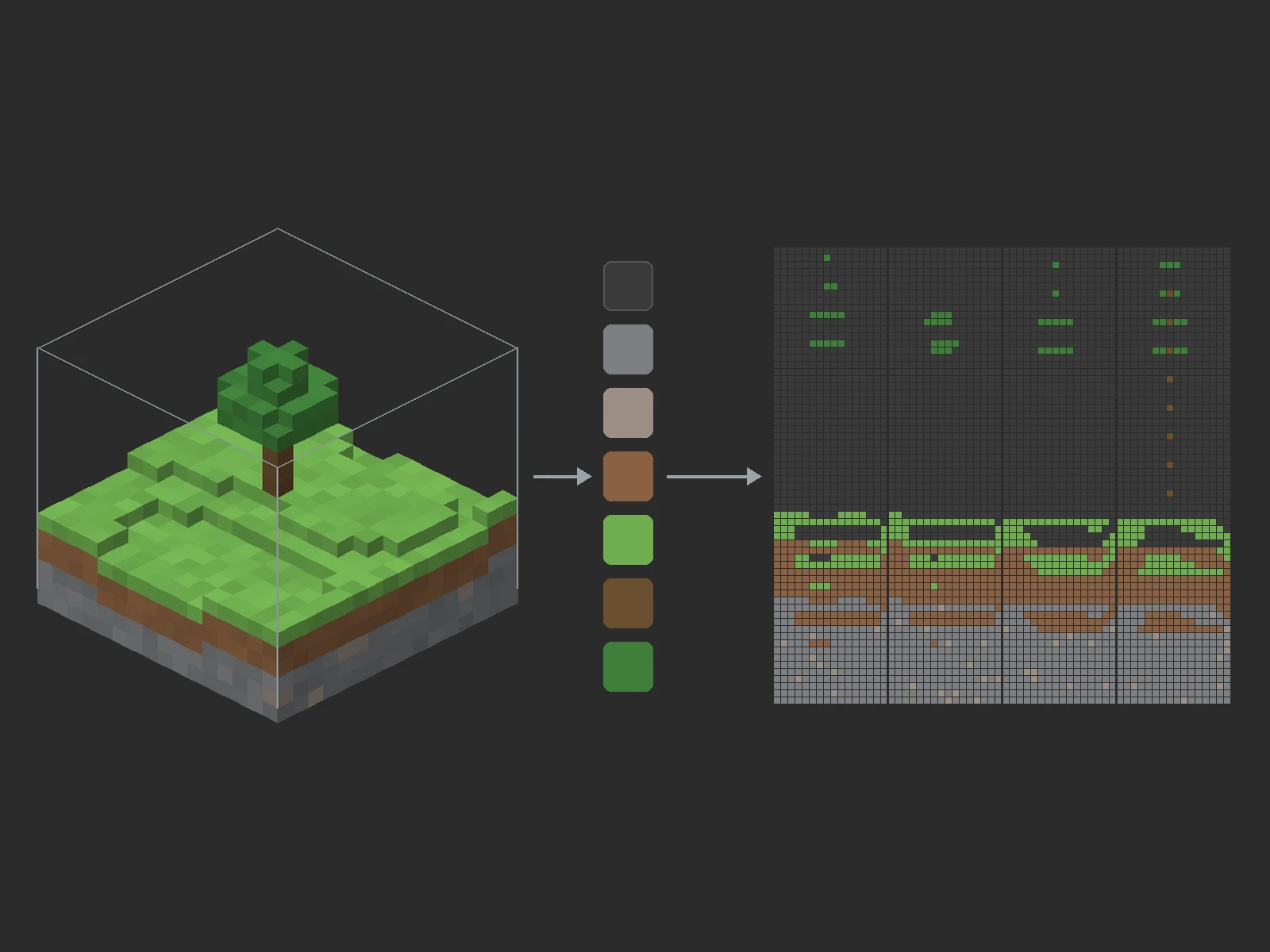
- Blocks are transferred from AsyncChunkSection to Minecraft Chunk Section while still compressed to maximize transfer speed.
- There are numerous other optimizations in the chunk write process that I will not cover here.
- When multiple chunks must be written back from a single AsyncWorld on a multi-core system, KAsyncWorld will write multiple chunks in parallel by multi-threading the writing of non-overlapping chunk edits.
- Write-back speeds are fast, usually 0.25-0.5ms per chunk during normal operation.
AsyncChunkSection
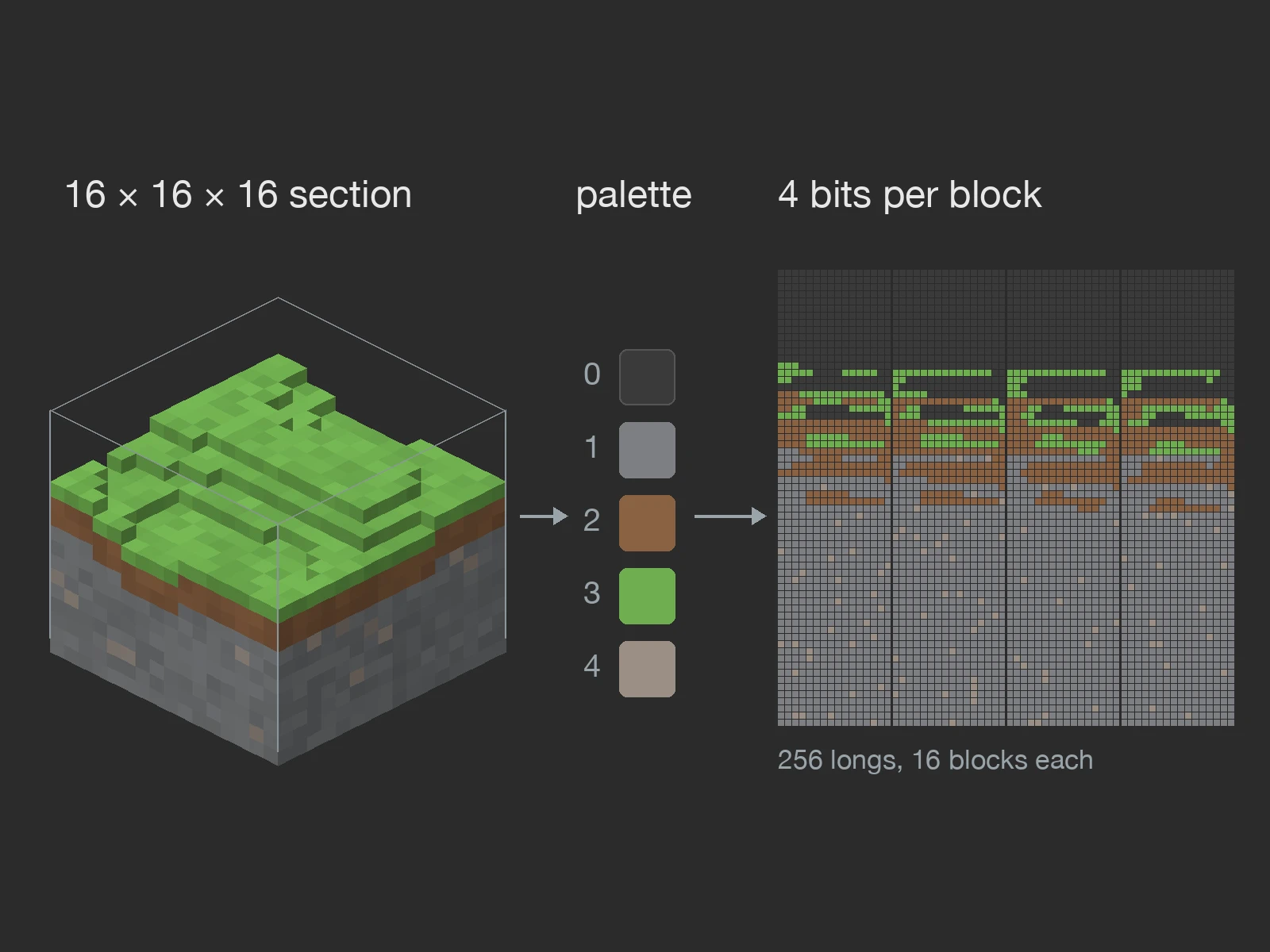
- Blocks are stored compressed, taking up as little as 4 bits per block and depending on the number of unique block types in a section (16x16x16 cube).
- The block information is stored in the exact format Minecraft internally stores blocks, this is done intentionally to make write-back as fast as possible.
- Sections not only track what blocks they are comprised of but also what blocks were actually changed
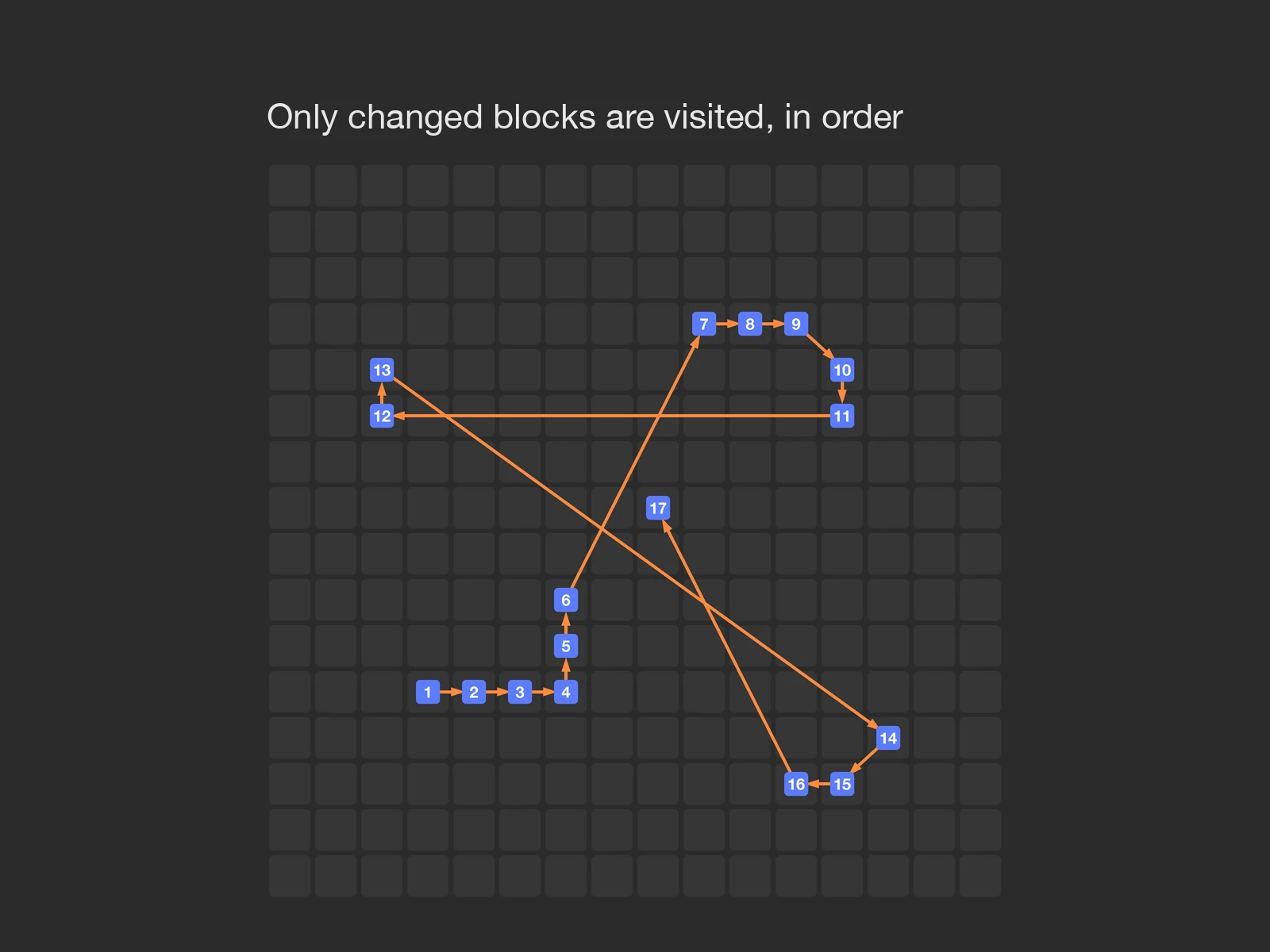
- Sections can be iterated over and will only iterate over the blocks that have actually been modified. Depending on the type of section, this may default to every block, but for most types (like what is given to you when you use EditType.SPARSE), the iteration order will be in the order the blocks were modified and furthermore only cover modified blocks, as the changes are tracked (in one of three ways depending on usage).
LinkedIterationStrategy
When you modify a block in an AsyncWorld that supports change tracking using Linked Iteration (most of them), if the block you changed has not already been modified, it will be linked into a 4096-entry array that acts as space for a linked list. When iterating over the modified section, the iterator will walk this linked list, covering the modified blocks in the order they were modified. This strategy is the default because it is the most performant in the average case. It is very quick for write-back as only changed blocks are iterated over and there is no seek time for finding the next changed block as there is with Flag Iteration which we will cover below.
FlagIterationStrategy
When using Flag Iteration, iteration is not ordered, and the changes are tracked using a bitmap of size 4096, stored as 64 longs. No guarantees are made on the iteration order, but only modified blocks will be iterated over. This strategy uses less memory than Linked Iteration but is often less performant in write-back because the whole bitmap must be iterated over.
NormalIterationStrategy
This is the simplest, iteration covers every block, modified or not, in a predictable order.
It should be noted that each section also stores how many of its blocks are dirty (changed) and also how many of each type of block it contains (modified or not).
Optimizations
- In the case that a section is completely dirty (4096 modified blocks) then write-back can be sped up by just transferring the whole data array to the minecraft chunk section instead of picking out individual blocks. This is a big part of the speed up KAsyncWorld provides as usually the data array will only be 256 64-bit longs (16 blocks per long).
- In the case that a section is completely air, and also completely dirty, then a further optimization can be made by just deleting that section from the world entirely.
Caveats
To transfer the data array directly to a minecraft chunk section, the compression encoding (block palette) needs to match, if they do not, the palette must be replaced. Luckily, palettes are quite small compared to the data storage, so this is quite fast.
In-Memory Worlds
- In-memory worlds are created quickly by skipping much of the setup that Minecraft usually performs, on the basis that much of it is unneeded and irrelevant for worlds used by projects that this library is meant to serve
- There is no chunk generation by default in these worlds.
- Chunks that are not in use by the Minecraft internals are cached in an encoded format (and potentially compressed) to save memory.
- Chunk loading by Minecraft internals is extremely fast as the chunks need not be loaded from disk, and are instead quickly uncompressed and decoded from memory.
- The chunk codec can be customized but a compact and fast implementation is provided as AW.compressedCodec.
Fun Fact
While writing here about one of the optimizations I had implemented, I discovered I never actually finished implementing that optimization. I finished it, and it increased write-back speed by 300% (in certain conditions).